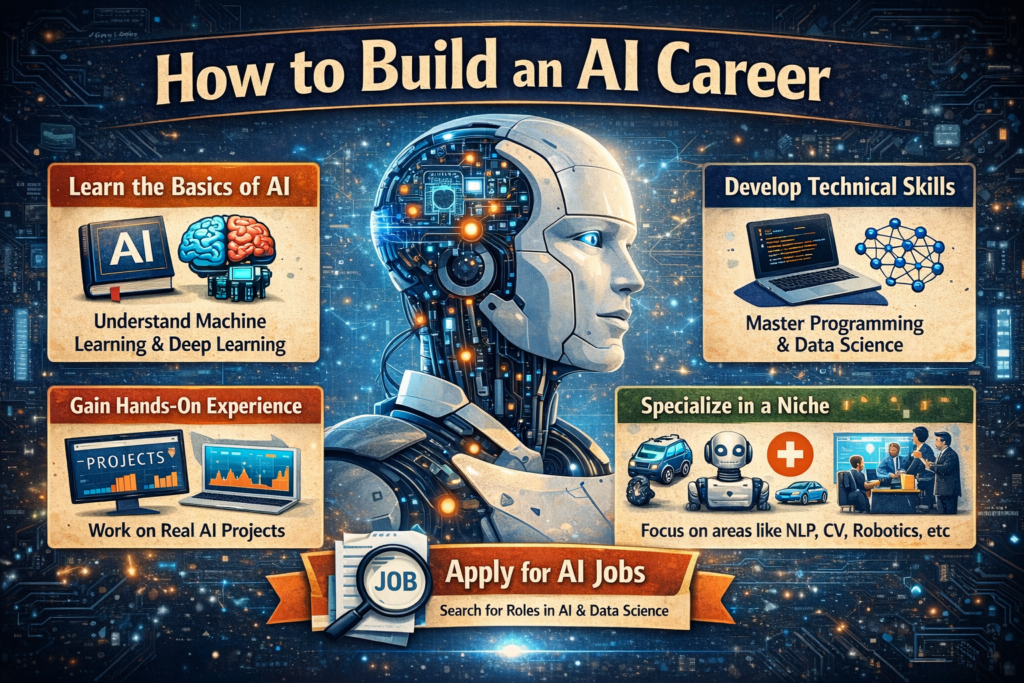
How to Build an AI Career – Step-by-Step Guide (2026)
How to Build an AI Career – Step‑by‑Step Blog (in English)
Right now, Artificial Intelligence (AI) is one of the most future‑proof and high‑growth fields in tech. Whether you’re a fresher, switching from another field, or still studying, this blog will give you a clear, practical roadmap to build a strong AI career.
1. First, Understand What AI Is
AI is not just about robots or chatbots. It’s the science of building systems that learn from data and make decisions similar to humans. Key areas include:
- Machine Learning (ML) – Algorithms that learn patterns from data.
- Deep Learning – Using neural networks to handle images, audio, and text.
- Natural Language Processing (NLP) – Making machines understand and respond to human language.
Once you know these basics, you’ll find it much easier to choose your target role inside AI.
2. Clarify Your Target Role
AI has many different job roles. Some of the most common are:
- Data Scientist – analyze data, find insights, and help businesses make decisions.
- Machine Learning Engineer – design, train, and deploy ML models in production.
- AI Researcher – work on new algorithms and cutting‑edge AI techniques.
- AI/NLP Engineer / Prompt Engineer – build and fine‑tune LLMs, chatbots, and generative AI tools.
Ask yourself:
- “Do I enjoy working with data and visualization?”
- “Do I love coding and designing algorithms?”
Your honest answers will naturally guide you toward the right role.
3. Build the Core Skills
Most AI roles expect three main skills:
a) Programming (Python)
- Learn Python: variables, loops, functions, data structures, and basic OOP.
- Use libraries like
pandas,numpy,matplotlib, andscikit‑learn.
b) Maths and Statistics
- Linear Algebra – matrices, vectors (very important for ML).
- Probability & Statistics – distributions, mean, variance, hypothesis testing.
- Basic Calculus – derivatives, gradients (needed for deep learning).
c) Data Science & ML Basics
- Learn data cleaning, exploratory data analysis (EDA).
- Understand simple ML concepts: regression, classification, and clustering.
4. Choose Your Right Path – Fast Track vs Deep Learning
If your goal is to land an AI job in 1–1.5 years, follow a practical, project‑driven path:
- Months 1–6: Learn Python, data science basics, and basic ML.
- Months 7–9: Build 3–5 small AI projects and put them on GitHub.
- Months 9–12: Try internships, freelance gigs, Kaggle competitions, or open‑source contributions.
If you aim for research or PhD‑level work, then a strong background in computer science, maths, or AI through graduation or post‑graduation becomes essential.
5. Build Projects and a Portfolio
In AI, your portfolio is your resume. Theory alone is not enough.
Some beginner‑friendly project ideas:
- Movie or product recommendation system
- Fake news detection classifier
- Simple chatbot (rule‑based or NLP‑based)
- Image classifier (cat vs dog, etc.)
Upload all projects to GitHub, and for each one, write a short description:
- What problem did you solve?
- What data did you use?
- Which model and techniques did you apply?
- What were the results?
This collection becomes your AI portfolio, which recruiters can actually see and test.
6. Join Kaggle, Hackathons, and Communities
AI is a highly collaborative field. To grow fast, get involved in:
- Kaggle – Solve small competitions to improve your coding and ML skills.
- Hackathons – work in teams under time pressure, which feels like real‑world AI work.
- LinkedIn & AI communities – share your projects, comment on others’ work, and follow experienced AI professionals.
These activities slowly build your personal brand as an AI learner, which helps a lot when companies start noticing you.
7. Optimize Your Resume and Prepare for Interviews
Once you have 5–7 solid projects and 1–2 internships or freelance experiences, start applying for jobs.
Resume tips:
- For each project, clearly mention: problem, data, model, metrics, and impact.
- List tools and frameworks you used (Python, PyTorch/TensorFlow, SQL, cloud basics).
Common interview topics:
- Python basics and OOP
- Data structures and algorithms
- Core ML concepts (overfitting, underfitting, bias–variance)
- Basic statistics and probability
- Deep discussion about your own projects
Always be ready to explain why you chose a particular model or technique and what you would improve next.
8. Keep Learning Continuously
AI changes every few months. To stay relevant:
- Try new tools and libraries (like Hugging Face, LangChain, LLM APIs).
- Read AI blogs, newsletters, and watch short tech videos.
- If your budget allows, take a structured online course (Coursera, Udemy, etc.) to level up fast.
The key is consistent learning, not last‑minute cramming.
9. Sample 1‑Year Learning Plan (for reference)
Here is a simple 1‑year plan you can customize:
| Months | Focus Area |
|---|---|
| 1–3 | Python, maths basics, pandas, numpy, simple ML models |
| 4–6 | Build 2–3 small AI projects, upload to GitHub |
| 7–9 | Join Kaggle, try mini internships or freelance work |
| 10–12 | Develop 1–2 advanced projects, polish portfolio, and prepare for interviews |
You can adjust this timeline based on your current knowledge, daily time, and goals.
10. Final Mindset Tips
Building an AI career is not a sprint; it’s a marathon.
- Focus on consistency, not motivation.
- Combine learning + practice + community for the best results.
- If you can dedicate just 1–2 hours every day, you will be job‑ready in AI within 1–1.5 years.